1. Executive Summary
 Today, enterprises rely on web map services to communicate and collaborate
with their staff members and customers, other enterprises, and the general
public. They increasingly rely on open source geospatial software to
deploy these services. These vital services are at risk, though, when they
are not backed by certified, supported, and well-documented services by
professional experts. OpenGeo was founded to solve this problem.
The OpenGeo Suite Enterprise Edition integrates the best features from
leading open source geospatial software communities into stable and
supported product offerings. These community projects, including
GeoServer, PostGIS,
OpenLayers, GeoWebCache
and GeoExt, are open for anyone to
use in application development. However, the rapidly changing nature of
community projects, as well as their lack of formal, reliable support and
integration, dictates that community projects are best suited for proof-of-concept
development. This paper outlines how the OpenGeo Suite Enterprise Edition
augments the innovation of these open source software communities with
the testing, certification, and maintenance necessary to create and maintain
reliable, long-term enterprise production web services. Further, it provides an
overview of OpenGeo Suite Enterprise Edition packages and their value for
organizations of any level of familiarity with open source web mapping.
Today, enterprises rely on web map services to communicate and collaborate
with their staff members and customers, other enterprises, and the general
public. They increasingly rely on open source geospatial software to
deploy these services. These vital services are at risk, though, when they
are not backed by certified, supported, and well-documented services by
professional experts. OpenGeo was founded to solve this problem.
The OpenGeo Suite Enterprise Edition integrates the best features from
leading open source geospatial software communities into stable and
supported product offerings. These community projects, including
GeoServer, PostGIS,
OpenLayers, GeoWebCache
and GeoExt, are open for anyone to
use in application development. However, the rapidly changing nature of
community projects, as well as their lack of formal, reliable support and
integration, dictates that community projects are best suited for proof-of-concept
development. This paper outlines how the OpenGeo Suite Enterprise Edition
augments the innovation of these open source software communities with
the testing, certification, and maintenance necessary to create and maintain
reliable, long-term enterprise production web services. Further, it provides an
overview of OpenGeo Suite Enterprise Edition packages and their value for
organizations of any level of familiarity with open source web mapping.
2. Architecture
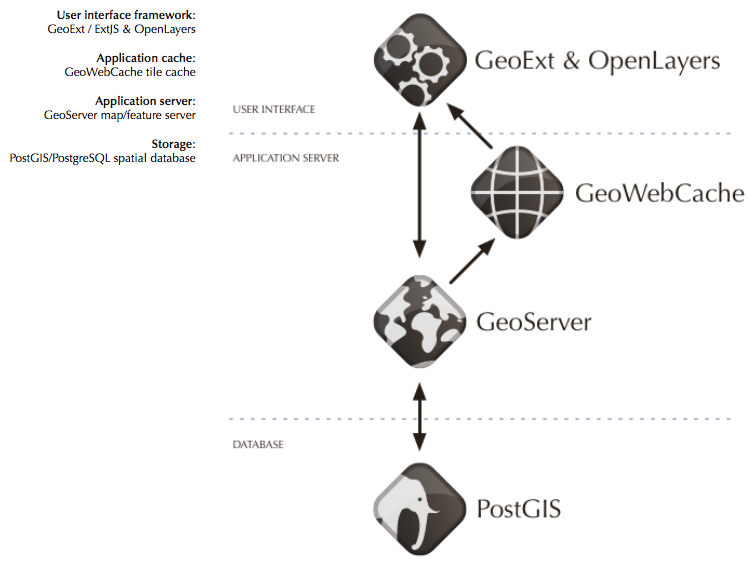
The OpenGeo Suite achieves a substantial performance advantage over other web mapping services through its flexible architecture. With a single code distribution, the OpenGeo Suite bundles together five open source community projects in a system that can be deployed as one unified whole, or as individual modules, right out-of-the-box. OpenGeo Suite components include PostGIS, GeoServer, GeoWebCache, OpenLayers, and GeoExt. The Enterprise Edition provides unlimited support to deployments of these individual components as well as to the bundled stack.
The power of the OpenGeo Suite is in the freedom it affords enterprises for production deployments. Its powerful components can be used together, individually, or in combination with existing infrastructures for maximum flexibility.
An effective architecture provides a complete solution, but in a modular manner. Typical legacy web mapping applications cannot offer such flexibility without completely rewriting a significant part of their code to take advantage of open standards. It is not enough to port existing software onto the web and expect it to work.
3. The Enterprise Advantage
As noted, the OpenGeo Suite builds one unified web mapping service from the ongoing developments of five separate open source communities. This software package is available in two versions: the fully-supported OpenGeo Suite Enterprise Edition, and the freely available, unsupported OpenGeo Suite Community Edition. A new Community Edition is released 10 or more times a year, bringing new features and the latest capabilities to users on frequent basis so that they can explore, experiment, and test the Suite’s latest features.
The easy access and usability of the OpenGeo Site Community Edition makes it a snap to use. IT professionals can quickly in set up new web mapping services with it. However, the lack of support for the Community Edition, as well as its rapid development cycle, makes it unsuitable in a production mode.
Stability and support need to accompany creativity and functionality when organizations deploy web map services in production. The OpenGeo Suite Enterprise Edition combines innovation and robust capabilities with the testing, certification, maintenance, and support necessary for software in production. The Enterprise Edition comes in four Levels – Basic, Professional, Platform and Strategic – to provide a range of service and cost options to organizations deploying production level web mapping services. All levels of support cover every OpenGeo Suite component, whether deployed individually or as part of a stack.
4. For Production
The OpenGeo Suite Enterprise Edition delivers the long-term support, updates, and backwards compatibility that organizations need for their enterprise systems. Using the OpenGeo Suite Enterprise Edition reduces testing and validation time, minimizes trouble-shooting and downtime, simplifies management, and enables organizations to refocus resources on higher-value projects. Developers and system administrators benefit from the stability, scalability, and power of the Enterprise Edition. Managers and users benefit from the long-term development and support that OpenGeo provides.
5. Support Contract or Software License?
Generally, proprietary software companies require that clients "license" their software and separately purchase annual maintenance. On top of that, clients are typically required to purchase separate licenses for plug-ins, database connectors, etc. As enterprise deployments succeed and become used more widely and frequently, the costs for licensing the software on more and more servers can lead to rapid and large cost increases. The "success" of a web services deployment can quickly turn into a nightmare of budget over-runs.
Users of the OpenGeo Suite Enterprise Edition avoid this trap: clients only pay for an annual subscription covering OpenGeo’s support and services – there is no "license" for the software. Furthermore, there are no extra fees to add up and drain budgets. OpenGeo’s support costs scale very slowly and offer Enterprise Edition users substantial savings versus proprietary offerings, when scaling to larger and larger configurations.
6. Side by Side Comparison: Enterprise vs. Community
| Enterprise Edition | Community Edition | |
|---|---|---|
| Long-term Stability |
|
|
| Integration |
|
|
| Patches & Updates |
|
|
| Enhancements |
|
|
| Security |
|
|
7. Increased Productivity: For all levels of users
| Enterprise Edition | Community Edition | |
|---|---|---|
| Access to Source Code |
|
|
| Support |
|
|
| Feature Development |
|
|
| Education |
|
|
| Quality Assurance |
|
|
| Compatibility |
|
|
The OpenGeo Suite Enterprise Edition increases organizational productivity by providing a flexible, certified, and scalable package to develop and deploy web mapping services. But an innovative software package can only increase productivity so much. Organizations evolve over time, and they require an infrastructure of support services from their software provides to support all levels of their users at all times within their application development cycles.
For organizations new to open source or web mapping services, OpenGeo provides, through the Enterprise Edition package, a complete web mapping software stack along with the education and support to easily deploy web mapping solutions on time and within budget. Some organizations with more experienced IT staff and developers may not run the Suite, but rely heavily on one or more of its components in their existing implementations. OpenGeo provides feature development for the components they depend on, as well as multi-level production support. OpenGeo Enterprise Edition comes with unlimited access to a team of experts dedicated to identifying specific issues and taking action. The expertise employed by OpenGeo means that a quick and comprehensive resolution to issues, bugs and upgrade support is something that an organization can rely on.
8. Summary
The OpenGeo Suite Enterprise Edition delivers the benefits of open source community projects without the risks and potential costs of deploying them in production or embedding them in a product for resale. Government agencies, IT organizations, and independent software vendors alike can greatly benefit from adopting the OpenGeo Suite Enterprise Edition as their choice for the development and deployment of mission-critical web mapping applications and services.
9. Risk-free Evaluation
It’s free and easy to gain access to complete OpenGeo platforms on a supported (Basic Level) evaluation basis.
10. About Us
OpenGeo is a social enterprise working to build the best web-based geospatial technology. The company brings the best practices of open source software to geospatial organizations around the world by providing enterprises with supported, tested, and integrated open source solutions to build the Geospatial Web. OpenGeo also supports open source communities by employing key developers of PostGIS, GeoServer, and OpenLayers. the company has provided successful consulting services and products to clients like the World Bank, Google, Ordnance Survey Great Britain, Portland TriMet, MassGIS, Landgate, and the Federal Communications Commission. OpenGeo is the geospatial division of OpenPlans, a New York-based 501(c)(3) non-profit that informs and engages communities through journalism and open source software. All of OpenGeo's revenue has been and will continue to be re-invested into innovative and useful software in support of the OpenPlans mission.
Redistributable under the Creative Commons Attribution-Share Alike license.
The OpenGeo Suite Enterprise Edition
Table of Contents
Other White Papers
Geospatial, An Open Source Microcosm
Open source has seen great success in general information processing, but does it have a future in vertical markets? In this article, we examine how geospatial open source provides an example of the market challenges of a mid-sized vertical market.
OpenGeo Sensor Web Enablement (SWE) Suite
the Open Geospatial Consortium (OGC) has been engaged in developing a set of standards for web-enabling sensors and sensor observations. Version 1.0 of the Sensor Web Enablement (SWE) standards were approved and released. Versions 2.0 of these standards have either been approved, or will be approved by Fall.
The OpenGeo Suite Enterprise Edition
This paper outlines how the OpenGeo Suite Enterprise Edition augments the innovation of open source software communities with the testing, certification, and maintenance necessary to create and maintain reliable, long-term enterprise production web services.
The OpenGeo Suite is built from several open source projects (OpenLayers, GeoWebCache, GeoServer, PostGIS) that each provide distinct functionality. This paper explains what each component does and how they interact with other components.
An Introduction to GeoWebCache
GeoWebCache is gaining popularity as enterprises look to accelerate their online maps. In this interview, Arne Kepp, the project founder and OpenGeo team member, provides historical background and technical details.
Caching to Improve GeoWeb Reliability
The SDI model of distributed service providers can fall apart when services or connectivity are unreliable. National infrastructure providers can increase SDE reliability by providing a maintained caching infrastructure on top of distrobuted services.
GeoServer in a production environment can be evaluated according to three criteria: reliability, availability, and performance. This paper discusses methods for implementing production grade GeoServer deployments.
OpenGeo proposes to develop the first-ever robust, enterprise-ready, open source geocoding solution, and is looking for partners to provide feedback on requirements as well as project funding.