Blog

Posts Tagged ‘geography’

The Earth is Not Flat: Volume 2

I really want the geography support in PostGIS to be good, so when I get tickets on it, I take the time to investigate, particularly when they say there are problems with correctness.

This recent ticket took a little while to visualize and confirm, and it’s worth showing so hopefully other folks can debug their issues on their own. The submitter basically said, “look, I have two squares, and I know the smaller one is contained in the larger, and I know that they both contain a marker, and yet when I run containment tests, they say the marker is only contained by the smaller square, but if the larger square contains the smaller it must logically also contain the marker!” And, helpfully, he included the SQL for the tests, which included the squares.

You can see where his concern comes from. The smaller square is inside the larger.

And the marker is inside both.

However, this is a visualization in mercator. The lines between vertices are being drawn as linear interpolations in planar space. The geography calculations involve great circles between vertices in spherical space. What does that look like?

Hm, the lower lines don’t actually line up.

And the marker is actually between the lower lines. It’s contained by the smaller square, but not by the larger one. Just like the geography tests said.

The moral of the story is, we aren’t good at visually reasoning about boundaries on a sphere. Our practice is all cartesian and it causes us to make mistakes.

This is something I learned during the development of geography, when I spent many hours debugging test cases that the code was getting “wrong” only to find in the end that the problem was entirely between my ears. (Example, does POINT(0 1) fall on LINESTRING(-1 1, 1 1)? If you said “yes”, you too have problems between your ears.)

So, plug your problem into KML LineStrings (not Polygons, they aren’t rendered as great circles!) and have a look before reporting correctness issues in geography, please!

Flattening the Peel

A PostGIS user asked me an interesting question this week, looking for the intersection of these two polygons:

POLYGON((170 50,170 72,-130 72,-130 50,170 50))
POLYGON((-170 68,-170 90,-141 90,-141 68,-170 68))

Now, from the coordinate sizes, you can see these shapes are described in longitude/latitude. So naturally you should consider using the PostGIS “geography” type, particularly since the shapes are quite big.

However, when you plug the shape into SQL and try out the calculation:

SELECT ST_AsText(
  ST_Intersection(
    ST_GeogFromText('POLYGON((170 50,170 72,-130 72,-130 50,170 50))'),
    ST_GeogFromText('POLYGON((-170 68,-170 90,-141 90,-141 68,-170 68))')
  ));

You get a bad result:

ERROR: transform: couldn't project point (-170 90 0): tolerance condition error (-20)

Hmm. Transform? This sounds like reprojection. We’re working in geography though, what’s going on? Check the definition of the ST_Intersects(geography, geography) function.

CREATE OR REPLACE FUNCTION ST_Intersection(geography, geography)
  RETURNS geography
  AS 'SELECT
    geography(
      ST_Transform(
        ST_Intersection(
          ST_Transform(
            geometry($1),
            _ST_BestSRID($1, $2)),
          ST_Transform(
            geometry($2),
            _ST_BestSRID($1, $2))
          ), 4326))'
  LANGUAGE 'SQL' IMMUTABLE STRICT;

Crazy stuff. Geographies are being cast to geometry, transformed into a planar projection (magically selected by _ST_BestSRID) intersected, then transformed back into geographics and cast back to geography.

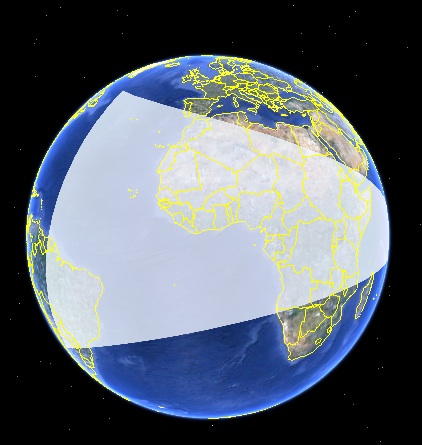
The problem is that _ST_BestSRID is failing to pick an appropriate projection to do the calculation in. Now, there are some shapes that are just too big to pick any projection for, but in this case the shapes are a good deal smaller than a hemisphere. However, they are inconveniently located:

One of them goes all the way up to the pole, but the other extends moderately far south. The “best SRID” routine evaluates first whether the shapes can fit into a single UTM zone (they can’t), if they are sufficiently far north to use a polar stereographic (only one is), and finally falls back to a world mercator projection. But, one of the shapes goes up to the pole (which mercator places at infinity), so in the end even the mercator projection fails.

What to do? In order to accurately derive a new shape in planar space that reflects the result on the sphere, we need a projection that represents great circles (used to connect points on the sphere) as straight lines (used to connect points on the plane). We need a Gnomic projection.
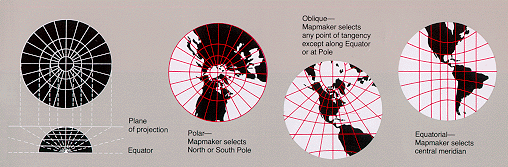
Fortunately the projection library underneath PostGIS — Proj4 — supports the gnomic projection. Now, we need a gnomic projection that is parameterized to optimally fit our geography shapes. The approximate center of the two shapes falls at (-160, 70) so we’ll use that as the center of the projection.

Now we insert a record into the PostGIS “spatial_ref_sys” table, giving our new projection an identifier number of 55000:

INSERT INTO spatial_ref_sys (srid, proj4text)
VALUES (55000, '+proj=gnom +lat_0=70 +lon_0=-160');

Now we can run the intersection again, this time in our specially chosen gnomic:

WITH shapes AS
(
SELECT
  ST_GeogFromText('POLYGON((170 50,170 72,-130 72,-130 50,170 50))') AS p1,
  ST_GeogFromText('POLYGON((-170 68,-170 90,-141 90,-141 68,-170 68))') AS p2
)
SELECT ST_AsText(
  geography(ST_Transform(
    ST_Intersection(
      ST_Transform(geometry(p1), 55000),
      ST_Transform(geometry(p2), 55000)
  ),4326)))
FROM shapes;

And this time we get a result:

POLYGON((-169.908 74.035,-141.155 73.424,-141 68,-170 68,-169.908 74.035))

As you can see eyeballing the globe above the resultant shape should have four corners (check), the southern two corners should be the southern two corners of the second input shape (check), and the northern two corners should be derived from the intersection of the northern edge of the first shape and the eastern/western edges of the second (check).

Astute readers of the geometry text will note that the northern edge of the first shape runs from (170 72) to (-130 72): why doesn’t the north edge of the derived shape fall on the 72d parallel? Because the shortest path between those points doesn’t run along the parallel, it’s a great circle arc that stretches to the north along its path.

This example has made it clear to me that the “best SRID” code needs a little upgrade, so that the logic first checks if UTM is acceptable, then switches into finding a best gnomic, and only breaks down and tries mercator if the shape is drastically too large to fit in a hemisphere.

“Best SRID” finding will always remain a hack, and direct math on the sphere is preferable, but for now we only have a few operations implemented on the sphere (area, length, distance) so we need some hacks to get our work done.
Down with Podal!

Are you anti-podal? So are many geographic edges!

Actually, not many, but it feels like a common first test case people try when they start playing with the geography type. “How far is it between 0,0 and 180,0?”

There’s a big problem with anti-podal edges though: they don’t have a determinate path. That is, to get from (0,0) to (180,0) it doesn’t matter what direction you travel, just start moving. Any other pairing of points generates a single great circle describing the shortest path joining them. So anti-podal points make very bad components of geometry: they don’t define a path, and they can’t bound an area, because only the end points have a determinate location.

Which brings me to my problem. How do I handle geography objects in PostGIS that include anti-podal segments? On the one hand, since they are impossible to do calculations against, I should just disallow them in all cases, and throw an error. On the other hand, people think they have meaning and stick them into functions all the time. There are also a few functions (like ST_Length) where it’s actually possible to calculate a valid answer given an antipodal input (because we know that antipodal points are exactly one half-circumference apart, even if we don’t know what direction someone might travel between them).

What do you think? Is there a best answer? Comments most welcome!

PostGIS gets Spherical

One of the items we launched with our new web site this spring was what we have been internally calling “the menu”, and ended up calling “core development“. The premise is that a generation of proprietary software experiences have broken customers of the idea that they can directly pay a vendor for a new feature — as customers we’ve been trained to just wait until the next version and hope. But in an open source world, developers (us) are happy to work on new features directly for customers. So in our core development “menu” we try to provide customers with some guidance about what is possible, writing up some descriptions of larger development pieces and enumerating the functionality they would provide.

One of the items I put in my PostGIS menu last spring was “geodetic types“, native support for latitude/longitude coordinates that allows for indexing of features that cross the poles or dateline, provides direct calculation of distances and areas on the spheroid, and integrates with the other functions in PostGIS. And a few months ago, that menu item was funded by a client! We are currently approaching the final delivery date, the code is committed to the PostGIS SVN repository, and I’m spending the rest of the week testing and polishing.

Amazingly, the open source development started paying off almost immediately — I was getting testing and bug reports from third parties very early in the process, which means the final delivery will be that much stronger for the client. I’ve also added a large number of functions above and beyond those itemized in the contract terms, since this code is going to be in wide use as soon as it is released.

To get a feel for the functions that have been added, check out the documentation for the upcoming PostGIS release. For more technical details on using the new type, see this post.