Blog

Archive for the ‘Team’ Category

GeoServer Featured on the Sourceforge Anvil Podcast

Our Justin Deoliveira recently graced the “airwaves” of the internet, speaking to Rich Bowen of the Sourceforge Anvil Podcast about the GeoServer project. GeoServer was one of SourceForge’s featured projects in February.

Check out the podcast and the transcript below or download on our Media Page .

Thanks to the host Rich Bowen and the SourceForge blog!

GeoServer on The Anvil Podcast:

Rich: I’m speaking with Justin Deoliveira, who is involved with the GeoServer project. GeoServer is a little over 10 years old and … almost 11 years old actually … and is a Java server for geospatial data.

Rich: Justin, can you tell us a bit more about what that means. How someone would actually use this product.

Justin: Sure, and thanks for having me on, Rich. As you mentioned, GeoServer is a GIS data server written in Java. What it allows for is the publishing and sharing of GIS, or geospatial data, on the web.

When I say GIS or geospatial data, what I mean is data that has location associated with it. When you’re looking at a map and you see a road or a building on a map, that building has some geospatial representation of it that allows us to place it on a map accordingly.

The analogy I usually use is GeoServer is sort of a specialized web server for geospatial data. Typically where we see it used is with web mapping. So using it as a back-end to create a Google Maps-type web map, but with full control over things like cartography and styling.

Rich: The data that’s included in this - where does that come from?

Justin: GeoServer ships with what we call “vanilla” or demo data, and that’s data that’s been gathered from all over the place. I believe there’s a subset of it that comes from New York City. But you’re certainly not constrained to that data. Typically people use GeoServer with their own data. So it might be a government agency that has satellite imagery or something like that, that they want to publish on the web. They can use GeoServer to connect to that data and serve it up for them.

Rich: Can you give me some examples of sites that are using this?

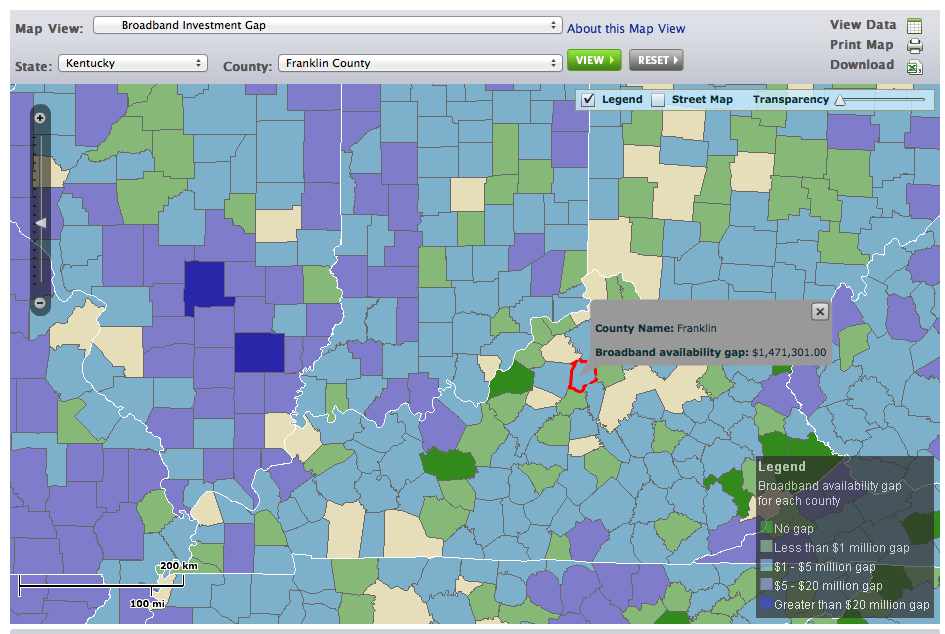
Justin: Certainly. We’ve seen a lot of uptick in GeoServer in the last two years. A lot of it we see in the government sector, from federal all the way down to municipal. For instance, the FCC uses it in something called their Broadband Map, which is essentially a map of high speed Internet connectivity across the United States. You can go to the map and see things like high-speed Internet density at a country-scale. You can also go down to the state- and county-scales as well. And that is all using GeoServer on the back-end.
broadband

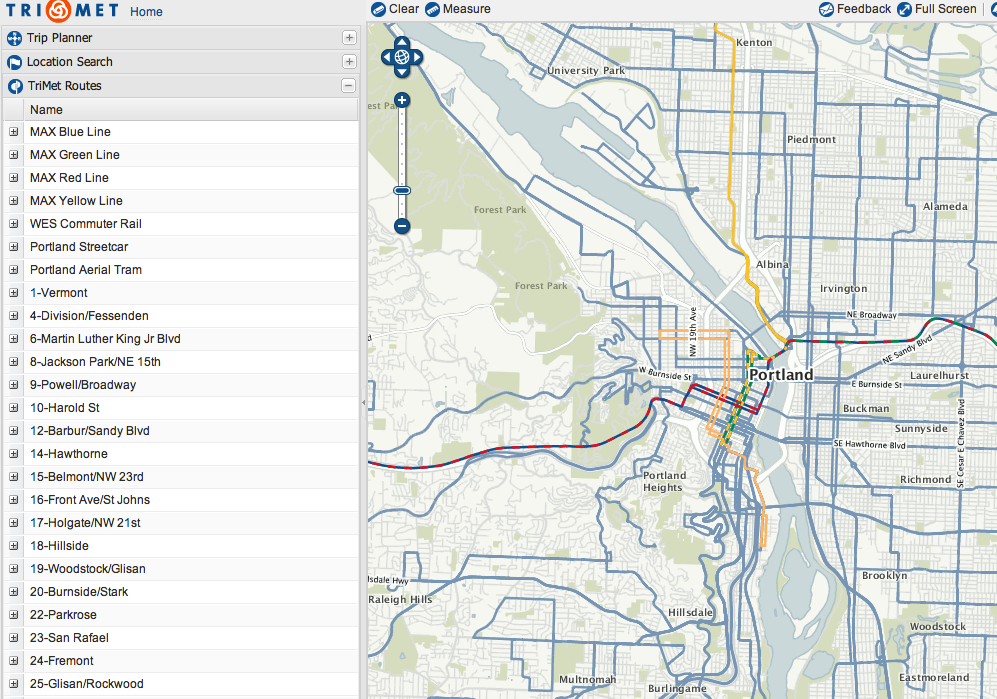
The city of Portland uses GeoServer in their transportation authority called TriMet. If you go to the TriMet site - TriMet, you’ll see a map of the Portland transportation network, with all the routes and stops, and that stuff on it. And it also comes with trip planner, where you put in a source and destination where you want to go, and the route is calculated and displayed on a map. That all comes with GeoServer on the back end.
trimet

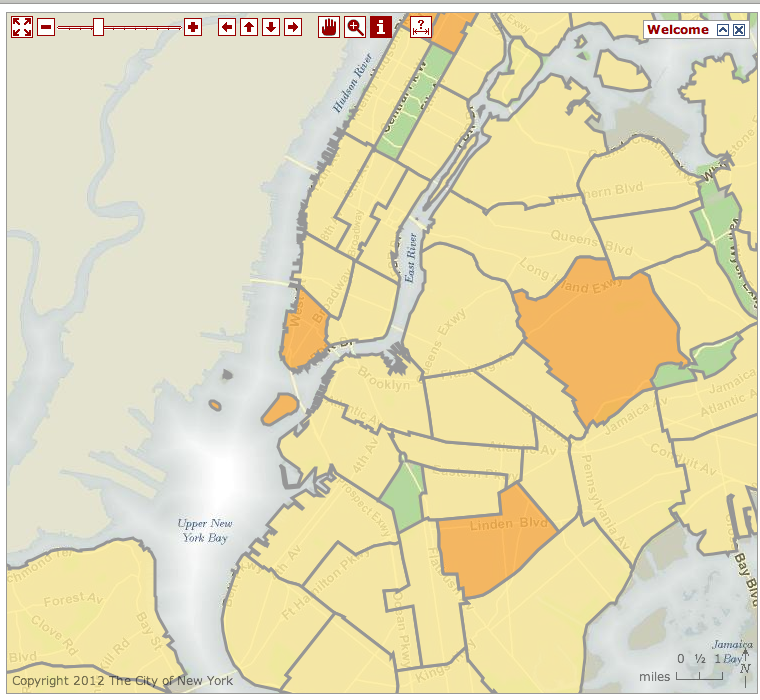
A final example is, New York City uses it in something called their SCOUT program. SCOUT stands for Street Conditions Observation UniT. Essentially how it works is, inspectors will go out in New York, and drive the streets, and they’ll report on conditions and events that they see, and those reports are fed back into their system, and displayed on a map, served by GeoServer in real time. That map is used by other agencies to allocate and dispatch resources accordingly.
SCOUT

Rich: The route finding stuff … is that included in to GeoServer as well?

Justin: The way Portland uses it is that they have their own route trip software that they use. So they do the route calculation and then push the result into GeoServer. However I should mention that it’s using something called Open Trip Planner, which is another Open Source project, and that’s an Open Source based trip-planning multi-modal project.

Rich: I see that you have a fairly sizable developer pool. What’s the process for somebody becoming a full developer on a project like this?

Justin: Good question. We don’t just hand commit access out, obviously, as most Open Source projects do. It’s all based on trust for us. What we encourage developers who interested in contributing, is to submit as many patches as they can. And we have formal review process for patches. Patches are commented on. We get the patch submitter to clean things up. Or we just apply the patch if it’s good enough. And once a developer has submitted enough patches, gaining the trust of the core developer community - we don’t have a specific number - they’re granted commit access.

We also have a module system in GeoServer. Someone might want to contribute just a module, and then they become the maintainer of that specific module. That gives them commit access for that specific module, but not necessarily to some of the other core modules.

Rich: Do you have a formal vote, or is it just consensus on the mailing list?

Justin: For things like patches, it’s pretty informal in terms of voting. We require that at least two core committers review a patch. They give their two “plus-ones”, and then the patch can be submitted. We also have a formal improvement proposal process, which we call GeoServer Improvement Proposal, and that’s more formal, and it’s really designed for larger changes. Things like architectural changes, breaking backwards compatibility, stuff like that. And that’s a formal process. We require the whole Project Steering Committee to vote on that, and there has to be more positive votes than negative.

Certainly it didn’t start off like that. In the early years - back in the early 2000′s - is was pretty informal, and it was one or two developers doing things pretty ad-hoc. As the development community grew, and people were doing more and more contributions, it really became more critical. And now it’s a framework we rely upon to move things on the project smoothly.

Rich: I noticed that there’s also commercial support available for GeoServer. Can you tell me about that.

Justin: I work for a company called OpenGeo, who essentially does that. We offer products that bundle GeoServer, and we provide support and training, customization for GeoServer. So it’s a pretty typical model of company monetizing open source - Red Hat or JBoss - having this Open Source core that’s based on GeoServer and other Open Source mapping projects, and then offering commercial support on top of that.

And there are other organizations that do as well - there’s a company in Italy called GeoSolutions that also offers the same level of commercial support as well.

Rich: Where’s this project going in the future?

Justin: The current stable version of GeoServer is 2.1, and the 2.2 release is coming probably within the next six months. A few pretty major themes have been focused on for 2.2: One is the cloud and clustering - working on features that make GeoServer scale better and making it easier to deploy GeoServer in a clustered environment.

As we see GeoServer adopted by more agencies - especially government agencies at the Federal level, obviously security becomes a major concern. 2.2 comes with a complete revamp of the GeoServer security system. It allows for more flexibility for hooking up to external security systems that might be in place, like LDAP servers. But also things like better password encryption.

Dealing with geospatial data means … there are a wide variety of formats of geospatial data, so we try to support as many of them as we can. 2.2 will also come with improvements to existing formats, and also support for new formats as well.

And then the final one might be … this is pretty experimental at this stage … We’re seeing more asking for true 3-D. Typically maps that you and I are used to looking are all two-dimensional. But there are people with 3-D data out there, and they do want to visualize it on a map, so providing 3-D capabilities as well.

Rich: I’m particularly interested in the Open Street Map project. Is there any overlap whatsoever between what you’re doing and what they’re doing?

Justin: Not really. The Open Street Map initiative is really on the data side of things, and GeoServer lives on the tool side of things. Open Street Map is this rich, really good crowdsourced data set, and then GeoServer would load Open Street Map data, and push it onto the web.

Rich: So, I could use the Open street Map data within GeoServer?

Justin: Certainly.

Rich: Cool!

If I were interested in getting involved in your project … I may have some Java experience or I may not. Tell me how I could plug into what you’re doing.

Justin: There are certainly numerous levels that people can get involved. The easiest one is probably just filing bugs in the issue tracker. Whenever users report issues or problems that they’re having in the forum, we encourage them to file those as bug reports. And if they do have some programming experience we certainly encourage them to submit a patch along with that bug report.

For those who might not have coding skills we also accept documentation patches. So if you’re a user who is familiar with a certain feature, and that feature might not be documented all that well, we certainly encourage you to submit a documentation patch, and help us with continually improving our documentation.

I’ll also mention translations. GeoServer comes with a web interface for doing administration. That interface needs to be internationalized into different languages. I think we support four or five different languages now, and we’re always looking for new people to do translations.

Rich: Thanks so much for speaking with me.

Justin: Thanks a lot for having me, Rich.

OpenGeo Connections: Meet David Winslow

Welcome to another edition of OpenGeo Connections. Today we’re sitting down with David Winslow, technical lead on GeoNode. David works out of OpenGeo’s NYC headquarters, is a member of the GeoNode Project Steering Committee, and a core commiter to GeoServer. David has been with OpenGeo for over four years and is an integral part of our GeoNode team.

OpenGeo’s David Dubovsky: Hi David, thanks for sitting down to chat.
David Winslow: It’s my pleasure.

(DD): Let’s jump right in - where are you from, where are you now, and how long have you been with OpenGeo?
(DW): I’m a Duke University comp-sci alum, I grew up in Virginia and now I live in Brooklyn. I’ve been with OpenGeo for about four and a half years now.

(DD): Four and a half years? Does that make you an elder statesman at OpenGeo?
(DW): We’ve grown a lot over that time but I wouldn’t say I’m an elder anything.

(DD): So, what brought you to join OpenGeo?
(DW): Before I came here I was studying computer science at Duke. I was attending a carrer fair when I met Vanessa Hamer, now our Vice President of Operations. The rest is history, I found her pitch intriguing as I wanted to work at a place that was devoted to open source and open data.

(DD): So you studied computer science? What about web mapping and open source?
(DW): At the time mapping was new to me. When I joined OpenPlans, which OpenGeo is a division of, we were called The Open Planning Project (TOPP). I was hired to work on a OpenCore, a tool that provided basic project infrastructure for those rallying around a cause - it included things like a wiki, calendar, blog etc.

(DD): And how did web mapping get onto your resume?
(DW): I really consider myself more of a nerd than a geo-nerd. Chris Holmes had helped develop GeoServer while at TOPP. OpenCore was one of his first implementations of GeoServer. The idea was for users would to utilize maps to share and disperse information. This would enable volunteers to identify points of interest, concern, in need of attention etc.

(DD): And Chris pulled you in to help with that?
(DW): Yes, I helped Chris integrate GeoServer, and that was my first experience with open source geospatial.

(DD): That’s great. So what are you primarily working on these days?
(DW): For OpenGeo I work mostly on GeoNode, both supporting the community work - making sure releases come out, helping with new development etc, and for OpenGeo I perform custom deployments and bringing new features into the project. Recent deployments required customization that would be beneficial to the broader community; right now I’m working on brigning those into main GeoNode project

In my spare time I’ve been working on GeoServer styling with CSS. Right now you can only edit styles for GeoServer in an XML format called SLD. CSS is a lot less complex to edit and would would really be a benefit to the community.

(DD): Interesting, the word is that your GeoNode work has had you traveling a lot, where have you been?
(DW): You can say that, last year I traveled to Fiji, Portland, Zurich, Jakarta, Denver for FOSS4G, the list goes on.

(DD): Wow, what were you doing in the South Pacific?
(DW): I was in Fiji for a GeoNode deployment at the Secretariat of the Pacific Community (SOPAC). The SPC acts as an information broker for all the South Pacific nations. They’re using GeoNode to serve up data they’ve collected and the results of a large study on disater management

In Jakarta I worked with The Australia-Indonesia Facility for Disaster Reduction (AIFDR) on a project called Risk in a box. They’re helping inform people who don’t have the ability to make disaster models what would happen if a disaster did strike their area. For example, what would happen to their community in the event of a four meter storm surge. The online calculator is based on GeoNode and all of the calculations are published as GeoNode data sets and layers.

(DD): Very interesting, has the travel slowed down at all
(DW): Well OpenGeo will be in Washington D.C. for FOSS4G North America and then in Portland for an organization wide get-together - so no, but the flights are shorter.

(DD): So what’s your claim to fame in OpenGeo?
(DW): I’ve touched at least one line of code in every piece of the OpenGeo stack - PostGIS, GeoExt, GeoServer, REST.API, KML etc. I don’t think many others in our organization can say that.

(DD): Well, I’m sure you’ll get some competition for that now. Thanks so much for letting us pick your brain.
(DW): I’m happy to talk any time.

If you want to get in touch with David look out for dwins in #geoserver or #geonode. He’s also active on the the GeoServer and GeoNode mailing lists.

GeoExt Code Sprint - Spring

OpenGeo is always eager to help advance open source geospatial software projects. When Andreas Hocevar told us that the GeoExt community was planning a code sprint for GeoExt 2.0 we were happy to get involved. The sprint is still in the planning stages and, unfortunately, not fully funded. Though many have contributed, we’re hoping others will join us in sponsoring this event.

GeoEXT and ExtJS 4
GeoExt enables building desktop-like GIS applications through the web. It is a Javascript framework that combines the GIS functionality of OpenLayers with the user interface of the ExtJS library provided by Sencha. GeoExt currently works with ExtJS 3 but that does not utilize the new features in ExtJS 4 (charting, harmonized API with Sencha Touch for mobile applications, and others). The upcoming code sprint will target developing GeoExt 2.0 to work with ExtJS 4 in order to leverage the newest features.

Participants
Representatives from the following companies have confirmed attendance and sponsorship:

  • OpenGeo
  • Camptocamp
  • terrestris
  • Mapgears

These organizations have provided core developers for GeoExt 1.x and have experience as service providers building applications with ExtJS 4. We’re excited to work with them again as we help develop GeoExt 2.0

Sponsor search
A week-long gathering of eight developers calls for a budget of $52,000. This covers travel, accommodations and partly the developers themselves. While much of this cost is being borne by the participating organizations we have not been able to close the gap.

We are looking for sponsors to help. Sponsors will be named explicitly and are encouraged to input their priorities for desired functionality in GeoExt 2.0.

Call for sponsorship
The participating organizations would like to invite all organizations and users utilizing GeoExt to sponsor the code sprint. Becoming a sponsor ensures the benefits from the new functions that will be implemented.

OpenGeo Connections: Meet Matt Priour

Welcome back to the newest edition of OpenGeo Connections. Today we’re excited to announce that Matt Priour has joined the OpenGeo team. Matt has a breadth of experience in both the open source and proprietary web mapping worlds with special expertise in the front-end components of the OpenGeo Suite. He has already made a big impact working on GeoNode projects, and his responsibilities have quickly expanded to work directly with more OpenGeo Suite components.

OpenGeo’s David Dubovsky (OG): Hello Matt, welcome to OpenGeo!
Matt Priour (MP): Hi, I’m thrilled to be here.

(OG): Tell us a little bit about yourself.
(MP): I’m a happily married father of two young children, a trained wildlife biologist, and a web-centric geospatial software developer with a primary focus on client-side development. I’m also a native Texan and love living here. My wife is a veterinarian, and I used to volunteer as an emergency veterinary technician.

(OG): Great, and how did you decide to get involved in the geospatial field?
(MP): Well I’ve always loved maps, aerial photos, and working with computers. I seemed to drift toward geospatial-related interests while in college at Texas A&M University. Later on, I made heavy use of GIS/GPS in my field research for my master’s degree.

(OG): So you didn’t go to school specifically for web development or GIS?
(MP): No, not really. After utilizing GIS/GPS so much in school I had a really solid background. Inevitably I became the “GIS guy” at my first job after school. Eventually that lead to forming my own business for custom desktop GIS projects, extensions, and scripts, and finally to specializing in producing custom geospatial web apps for my clients.

(OG): And how long have you been at it now?
(MP): I’ve been working with geospatial in some form or another since 1999. I’ve been primarily focused on open-source geospatial technologies and web .

(OG): During that time what projects do you look back on most fondly?
(MP): I’ve really enjoyed any project which has allowed me the opportunity to solve an interesting problem for a client. Two such projects come to mind:
First, ParkScore, which was a demonstration project for the California chapter of Trust for Public Land. ParkScore allowed users to enter their addresses and be presented with an interactive map and results tables showing them the distance to public parks, schools, fitness centers, and other “healthily living” opportunities. Data had to be retrieved and compiled from a variety of sources using documented and undocumented API’s and displayed on a map in a rapid, per formant manner. I also developed a YUI based mapping app interface through this project that I was able to re-use on several other projects.

(OG): That sounds pretty interesting, and the second?
(MP): The second was a train tracking and incident management app which consolidated 3 separate inoperable desktop programs into a single unified map-based interface using GeoServer, GeoExt, and OpenLayers. It presented the problem of how to display large amounts of rapidly changing data with dynamic client-side filtering and specialization using OGC methods. Several GeoServer-specific vendor parameters, filter functions, and some SLD magic made this into a much more manageable task.

(OG): Wow, so you got to work with OpenGeo Suite components. Is that how you became involved with OpenGeo?
(MP): I’ve been tracking OpenGeo’s growth since it was a part of “The Open Planning Project”. This organization has done so much to promote open-source geospatial technologies and helped position it as a real alternative to proprietary systems. I was very excited when an opportunity to provide some development services related to temporal mapping for the MapStory project presented itself this summer.

(OG): So what will you be doing here at OpenGeo?
(MP): Along with the MapStory project I’ll be providing support for clients implementing, customizing or extending portions of the OpenGeo Suite.

(OG): Before we wrap up is there any interesting facts you’d like to reveal to the world?
(MP): Hmm, I can think of a few. I can do a rather good Beaker (from the Muppets) impersonation, in fact I was able to convince my wife to continue going out with me after our first date with that impression. Also I know over 100 North American songbirds by sound alone.

(OG): Wow - I honestly couldn’t say which one is more impressive! Thanks for the time and welcome aboard, Matt!
(MP): Glad to join the team!

OpenGeo Connections: Meet Martin Davis

Martin Davis is a leading figure in the geospatial development community and also one of the newest additions to the OpenGeo team. Martin will be working out of our new Victoria office and we’re excited to feature him as the first profile in our new series OpenGeo Connections, where we’ll introduce you to some of the geospatial experts that make OpenGeo, well, OpenGeo. Prior to joining us Martin contributed to the development of the JTS Topology Suite, and also initiated the JUMP Universal Mapping Platform, JCS Conflation Suite and RoadMatcher projects.

At this years FOSS4G conference, Martin was recognized with the Sol Katz Award for achievement in open source geospatial software.

OpenGeo’s David Dubovsky (OG): Martin, welcome to the team!

Martin Davis (MD): Thanks, I’m happy to be here.

OG: How did you get involved with OpenGeo?

MD: Well, I’ve always kept an eye on the development of GeoServer; since it’s the heavy hitter in the geospatial Java world, naturally there’s many OpenGeo connections there. Also, over the years I’ve kept in close contact with [OpenGeo's] Paul Ramsey and Justin Deolivera, so I often heard about what the organization was doing with the Suite and the other projects within it. When things aligned where I was free and OpenGeo had a position open, I jumped at the chance to work with a great team of developers.

OG: How did you come to software development? Did you go to school for it?

MD: I started my undergraduate degree in Physics, but quickly found that I was all thumbs at the experimental side (never could get those spark carts to work correctly…). But I still really liked building things - and software provided that buzz. So I switched to Mathematics and Computer Science, and have never regretted the choice.

OG: So you didn’t go to college planning to have a career in the geospatial field?

MD: Well I took a university course on Computational Geometry, and the combination of mathematics and visual geometry had a real appeal. Plus, I’m quite active in the outdoors, so I spend lots of time looking at maps! As for a career, I worked for the Ministry of Forests in the mid 1990s in a section of the IT group that was specializing in advanced spatial applications. From them on, I was hooked.

OG: And how long have you been at it now?

MD: Since 1994 - so over 15 years now.

OG: What other kinds of jobs did you have during, or before, that career?

MD: Looking back I had a bewildering variety of mostly interesting jobs in the early years of my career - including writing various parts of several research compilers (including one for Lucid, a dataflow language far ahead of its time); working on a expert system (remember those?) for psychological diagnosis, creating the “firmware” (on a Radio Shack Model 100) for an Active Drifter, an open-ocean buoy which maintained station and radioed back weather data; and building a Software-based training tool for Air Traffic Control equipment

OG: What about the geospatial projects you’ve worked on. Which do you look back on most fondly?

MD: Of course my on-going work on JTS stands out most of all. Some other interesting projects have been the JCS Conflation Suite, building road network conflation tools for the BC Digital Road Atlas, and working on generating heights of land and stream watersheds for the BC Freshwater Atlas.

OG: What projects will you be working on with OpenGeo?

MD: I’m working with the Support team, as a way of learning the products and the client base. I’m also working on a wide set of enhancements being funded by clients, specifically on catalog improvements. And there seems to be no shortage of other interesting things to get involved in!

OG: So you’ll be working from OpenGeo’s new Victoria office?

MD: Yes, I’m happy to work out of the new office. I live in Victoria with my wife and 3-year old son (who I’m expecting to discover computers any day now!). I’ve lived in Victoria for most of my life and it’s a great place to be if you don’t like shoveling snow.

OG: Congratulations on winning the Sol Katz Award and welcome aboard. Last question, With you and Paul Ramsey in the same office, will there be too many Sol Katz award winners for a conducive work environment?

MD: Thanks, it was a great honor to win the award and represent the Java tribe. I’ve got no concern about working with Paul as long as there’s enough desk space for me and my award. Happy to join the team!

GIS without Borders at the ILGISA Fall Conference

This week Paul Ramsey will fill in as keynote speaker at the the Illinois GIS Association Fall Conference at Northern Illinois University. This year’s conference theme is “GIS without Borders” and has a special focus on open source geospatial software. The conference takes placeOctober 18th and 19th. Paul’s keynote, entitled “The Unknowns,” will explore the culture of open source and why managers should explore open source in their organizations.

If you’re in the area and haven’t had the opportunity to see Paul speak then now is your chance. The keynote is scheduled for 9:00am on October 19th. Online registration for the conference is still open!

Out and About

We’ve done it again! Five of the OpenGeo workshops at FOSS4G have sold out. This response has us even more excited for this year’s conference.

  • Introduction to PostGIS, Paul Ramsey and Sam Smith
  • Web Mapping with GeoServer, Mike Pumphrey
  • OpenLayers Application Development, Tim Schaub
  • Developing OGC Compliant Web Applications With GeoExt, Andreas Hocevar
  • A Complete Open Source Web Mapping Stack, Alyssa Wright and Ian Schneider

Don’t worry, there are still plenty of opportunities at FOSS4G to learn about OpenGeo. Tickets are still available for the Opening Data with GeoNode workshop, and for more in depth discussions, there’s always our Meet The Experts sessions.

Outside of Denver there are other opportunities to meet OpenGeo team members. This week, Eddie Pickle will be at the MIL-OSS conference in Atlanta to discuss GeoNode, and its collaborative abilities. If you’re in the Atlanta area and want to find out about GeoNode, or how the military is using open source technologies it will be a worthwhile conference to attend.

Later in September we’ll be attending the National States Geographic Information Council (NSGIC) annual conference, followed by exhibiting at GEOINT in October.

Will you be attending these conferences? Want to set to set up a meeting, become a partner, or get involved in open-source communities? Contact us to find out more. The schedules are filling up quickly!

Hope to see you out there.

Meet the Experts at FOSS4G

Want expert advice about our open source projects from our real live developers? Come by booth #12 during FOSS4G next month and take advantage our Meet the Experts sessions. In addition to their workshops and tutorials, the OpenGeo Suite developers and team members will be available to answer questions and hear your feedback at the following times throughout the conference:

Wednesday, 9/14/2011

  • GeoServer and GeoWebCache, 10:00-12:00: Gabriel Roldán, David Winslow, Ian Schneider, Justin Deoliveira, Sam Smith
  • PostGIS, 12:45 to 14:30: Paul Ramsey, Sam Smith
  • GeoNode, 14:30-16:15: Andreas Hocevar, David Winslow, Jeff Johnson, Rolando Peñate
  • OpenLayers and GeoExt, 16:15 to 18:00: Andreas Hocevar, Bart van den Eijnden, Tim Schaub

Thursday, 9/15/2011

  • GeoNode, 10:00-12:00: Andreas Hocevar, David Winslow, Jeff Johnson, Rolando Peñate
  • OpenLayers and GeoExt, 12:45 to 14:30: Andreas Hocevar, Bart van den Eijnden, Tim Schaub
  • PostGIS, 14:30 to 16:15: Paul Ramsey, Sam Smith
  • GeoServer and GeoWebCache, 16:15-18:00: Gabriel Roldán, Ian Schneider, Justin Deoliveira, Sam Smith

We hope to see you there!

Denver, here we come!

There will be plenty of opportunities to learn at this year’s FOSS4G Conference. We’ll once again be attending en masse—not only are we Gold Sponsors but we’lll have nearly two dozen OpenGeo team members in attendance. Along with the first ever OpenGeo Partner Event , we’ll be presenting at nine workshops and tutorials so we’re sure to have an exciting (and busy!) week.

Remember to register for the conference, workshops, and tutorials. If previous years are any indication, they have a habit of filling up. If you’ll be at the show, come by booth #12 to see what’s new or get involved with the communities we work with. Look for us in our signature brown t-shirts. Want your own? Come to one of our workshops, we’ll be giving out t-shirt vouchers there!

Here’s a list of all of the events we’re involved with, all at the Sheraton Denver Downtown:

Date Event Start Time End Time Location Speaker/Attending
9/12/2025 Introduction to PostGIS 8:00:00 12:00:00 Windows Paul Ramsey & Sam Smith
Web Mapping with GeoServer 13:00:00 17:00:00 Tower Court D Mike Pumphrey
OpenLayers Application Development 13:00:00 17:00:00 Windows Tim Schaub
9/13/2011 Developing OGC Compliant Web Applications With GeoExt 8:00:00 12:00:00 Windows Andreas Hocevar
Opening Data with GeoNode 8:00:00 12:00:00 Silver David Winslow & Jeff Johnson
A complete open source web mapping stack 13:00:00 17:00:00 Tower Court D Sam Smith, Ian Schneider & Alyssa Wright
9/14/2011 An exploration of open source business models 9:10:00 9:30:00 Ballroom Paul Ramsey
State of PostGIS 10:00:00 10:30:00 Windows Paul Ramsey
Designing a better SDI 10:00:00 10:30:00 Denver Rolando Peñate
The State of GeoServer
13:00:00 13:30:00 Windows Justin Deoliveira
Tutorial: GeoServer Scripting with Python and RESTConfig 13:00:00 13:30:00 Century David Winslow
Introducing GXP: Webmapping made easy 15:00:00 15:30:00 Tower Court B Bart van den Eijnden
GeoScript - Spatial Capabilities for Scripting Languages
15:30:00 16:00:00 Tower Court D Justin Deoliveira
Scripting GeoServer with GeoScriptScripting GeoServer with GeoScript
16:00:00 16:30:00 Tower Court D Justin Deoliveira & Tim Schaub
Exhibitor Reception; Birds of a Feather; Poster Session 17:30:00 20:00:00 Ballroom Rolando Peñate
9/15/2011 Tutorial: Map Caching with GeoWebCache 10:00:00 11:30:00 Century Gabriel Roldan
OpenLayers Mobile 10:30:00 11:00:00 Windows Tim Schaub
Mapnik2GeoTools 13:30:00 14:00:00 Silver Alyssa Wright & David Winslow
Tutorial: Working with GeoScript 15:00:00 16:30:00 Century Justin Deoliveira & Tim Schaub
9/16/2011 Tips for the PostGIS Power User
10:00:00 10:30:00 Windows Paul Ramsey

Are you JavaScriptaculous?

Then perhaps you want to work with OpenGeo! We are looking for a JavaScript expert to join our team.

You will become a member of our front-end development team, using the OpenGeo Suite to build advanced web mapping applications for a wide variety of clients. Our software allows researchers, planners, and others to share and edit data using open standards. Our platforms have grown into true, open communities, with a focus on usability, modularity, and good documentation.

Join us. It’s bliss.